
I just enjoyed watching a Brazilian/Argentinian/French film titled Found Memories, directed by Julia Murat and released in 2011. I have to hope that the Portuguese title suffered in translation; the English version doesn't do justice or attract sufficient attention to the unique, exquisitely visual nature of this film. It considers the impact Rita, a young photographer, makes on a remote mountain village she discovers, almost by chance. The village is bound in time by its rituals. Roles are set, life proceeds in repetitive fashion. Days don't progress, they simply repeat. Rain is always coming, the coffee is always bad. Murat's pacing is slow and deliberate, allowing us to absorb details in a multi-sensory way. The point of view varies, from day to day, so we know we are seeing the moment fresh, even if the actions are effectively identical from sequence to sequence.

The photographer's arrival makes everyone see things anew. She asks questions. She doesn't accept silence or conventional answers. She pushes into new spaces. Her vision takes us--villagers and film viewers alike--into physical and psychological terrain we were previously kept from entering. She refuses to accept the "entry prohibited" sign on the church burial ground.
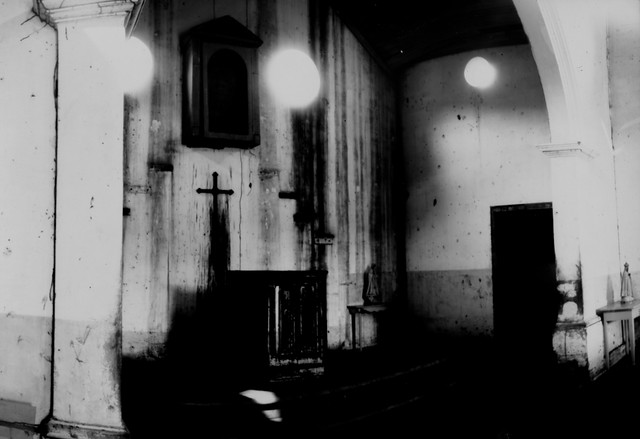
In order to effectively portray this character, someone had to take real pictures. And this is where my interest really gets piqued. It's like in a novel, one of those fictographic ones I sometimes quote from, when I read the acknowledgments and learn who inspired or informed the author about photography. In Found Memories, the photos come from someone whose Flickr page is called "Quito sometimes Marcos." They are pinhole photographs, and some seem to be made directly from locations in the movie.

The chiaroscuro effects of the pinhole images are the perfect echo for the simplicity of darkness and light, shutters open or closed tight, that seems to characterize the village prior to Rita's arrival. And in the end of the film, we are left to speculate whether her photographs will take on new shades of gray as she contemplates an extended future with the community. It's a gorgeous film, and I recommend both it and the photographs that informed it.
Found Memories link to (distributor) filmmovement.com
"Quito sometimes Marcos" on Flickr link


 Posts
Posts

