Showing posts with label fictographica. Show all posts

26 September 2013

filmographica

I am always intrigued by fictive portrayals of photographers and the narrative or symbolic use of photography in various contexts. Being a student of the medium and an admirer of its great practitioners, I like to encounter constructed versions of it by others.


I just enjoyed watching a Brazilian/Argentinian/French film titled Found Memories, directed by Julia Murat and released in 2011. I have to hope that the Portuguese title suffered in translation; the English version doesn't do justice or attract sufficient attention to the unique, exquisitely visual nature of this film. It considers the impact Rita, a young photographer, makes on a remote mountain village she discovers, almost by chance. The village is bound in time by its rituals. Roles are set, life proceeds in repetitive fashion. Days don't progress, they simply repeat. Rain is always coming, the coffee is always bad. Murat's pacing is slow and deliberate, allowing us to absorb details in a multi-sensory way. The point of view varies, from day to day, so we know we are seeing the moment fresh, even if the actions are effectively identical from sequence to sequence.


The photographer's arrival makes everyone see things anew. She asks questions. She doesn't accept silence or conventional answers. She pushes into new spaces. Her vision takes us--villagers and film viewers alike--into physical and psychological terrain we were previously kept from entering. She refuses to accept the "entry prohibited" sign on the church burial ground.
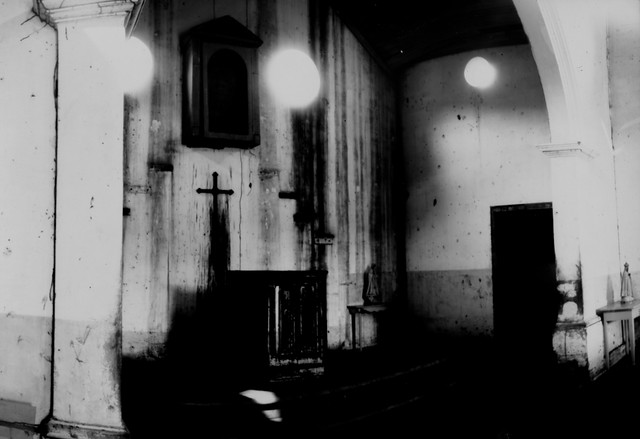


In order to effectively portray this character, someone had to take real pictures. And this is where my interest really gets piqued. It's like in a novel, one of those fictographic ones I sometimes quote from, when I read the acknowledgments and learn who inspired or informed the author about photography. In Found Memories, the photos come from someone whose Flickr page is called "Quito sometimes Marcos." They are pinhole photographs, and some seem to be made directly from locations in the movie.


The chiaroscuro effects of the pinhole images are the perfect echo for the simplicity of darkness and light, shutters open or closed tight, that seems to characterize the village prior to Rita's arrival. And in the end of the film, we are left to speculate whether her photographs will take on new shades of gray as she contemplates an extended future with the community. It's a gorgeous film, and I recommend both it and the photographs that informed it.

Found Memories link to (distributor) filmmovement.com
"Quito sometimes Marcos" on Flickr link


12 February 2011

fictographica007: Maude Coffin Pratt

It had been Stieglitz who'd refused to exhibit my work in New York--the Provincetown show I had had such hopes for. It seemed to me that Stieglitz in denying me this exposure was trying to thwart me in my courtship of Orlando. Or course, he knew nothing of Orlando, but the fact remained that my sole intention in studying photography was ultimately to persuade my brother that his proper place was with me in my darkroom. Stieglitz had spurned my photographs and in so doing had belittled me as a lover.

If Stieglitz didn't like it, it wasn't photography. Though I considered him of small importance--simply a man who had bamboozled a doting group of people with his lugubrious attentions--I knew that when Stieglitz loaded his camera the world said cheese, or at least his sycophants thought so. He was enthroned in New York in An American Place, his own gallery, and no one could call himself a photographer who had not first wormed some approval from this dubious man. I supposed I could be accused of bias, but I believed the clearest example of his complete lack of judgment and taste was his failure to recognize me as an original.
--Picture Palace

29 August 2010

fictographica006: Ophelia, Storyville Diary

Bellocq - April 1911

There comes a quiet man now to my room--
Papa Bellocq, his camera on his back.
He wants nothing, he says, but to take me
as I would arrange myself, fully clothed--
a brooch at my throat, my white hat angled
just so--or not, the smooth map of my flesh
awash in afternoon light. In my room
everything's a prop for his composition--
brass spittoon in the corner, the silver
mirror, brush and comb of my toilette.
I try to pose as I think he would like--shy
at first, then bolder. I'm not so foolish
that I don't know this photograph we make
will bear the stamp of his name, not mine.

--Natasha Trethewey, Bellocq's Ophelia (2002)

06 June 2010

fictographica005: Wilfred Eng

For much of his life he had operated a commercial portrait studio on Grant Street in San Francisco, which he occasionally closed to indulge his famous wanderlust. Among the Aperture images reprinted from the 1870s was a picture made in that studio of a Chinese woman and her son seated on the same divan as the one in the self-portraits. The pattern of the fabric matched. A small tear appeared in one corner. When I bent over the broken plate with a loupe, I saw the same tear and said, "Holy shit," out loud. The five self-portraits had been made in San Francisco  and must have been brought here some time later. Eng must have brought them himself. Given that they were cumbersome and easily broken, I wondered why he'd bothered. Vanity, maybe. "This man loves his mirrors," Alfred Stieglitz had observed when the two first met. In 1912 he had invited Eng to show at his 291 Gallery, which had marked the beginning of their prickly friendship. "Wherever we walked, even along busy streets," Stieglitz wrote, "he was forever giving bird-like twitches of his head in order to catch glimpses of himself in shop windows."
--The Lost Glass Plates of Wilfred Eng

20 March 2010

fictographica004: Carter Cox

Hearing the Borkhardt Group's account director clear her throat for the third time, you sigh and select a ring-flash to gently flood the girl's upturned face with what you consider to be a softer, more glamorous light. You recall from almost three decades ago your mother's sage advice: "If you pictures aren't interesting enough, honey, then chances are you're not close enough." You raise high the ring-flash and lean forward. But your move leads to louder throat-clearing. You lower the Hasselblad, pinch your nose, and for several seconds pretend to examine the dead grass. The skin of your cheekbones tightens as you feel yourself teeter between embarrassment and anger. Still kneeling, your hooded sweater damp with sweat, you swivel your head and lock eyes with the Borkhardt woman, who stares back at you with a mirthless smile, unblinking, her hands clasped just below her vested bosom, as if entranced by your ineptitude. "More sheen," she commands, albeit quietly, in a raspy voice, directing your yawning assistant to spritz the model's face and shoulders with a plastic water-bottle that appears out of nowhere. "More sheen, less sweetness. This isn't a portrait--it's an attitude. And do you mind if we kill the Caruso?"
--Hungry Ghost

04 March 2010

fictographica002: Maude Coffin Pratt

The trouble with cameras is that people see them a mile away and they get self-conscious and sneeze out their souls and put on that numbed guilty expression and act as if you are going to shoot them dead. Or worse, they pose like dummies and show their teeth: even your bare-assed savage knows how to say cheese. As a photographer I was embarrassed to be caught with that contraption in my mitts, like an elderly pervert, a distinguished old lady with my skirt around my neck frightening children at play. Later, I was proud of the way I could conceal my intention and, long before the Japanese produced their tiny instruments, I could disguise my camera--as a shoe box or a handbag or as a ridiculous hat that people gaped at, not knowing that I was recording their curious squints. Orthodox Jewish Boys, a small group of dark-eyed youngsters with beanies and sidecurls--some critics found them a bizarre evocation of alienated Americans ignoring the squalor of downtown Brooklyn and looking skyward toward Jehovah--are just some curious kids looking at my hat.
--Paul Theroux, Picture Palace (1978)

01 March 2010

fictographica001: Carter Cox

You glance across the den at the twin-lens Rolleiflex, your very first camera, given to you as a birthday present by your mother twenty-seven years ago today, collecting dust on the bookshelf next to the unopened UPS package containing an unneeded CD-ROM drive for your new laptop computer. "Don't just capture the thing itself," your mother--an ambitious amateur photographer--had said in a calm, soothing voice, when you showed her your earliest efforts. "Look and find the thing's sum and substance. And be more gentle with natural light," she would encourage, "but more ruthless with your framing. Make art, Carter. You have it in you."

As a young man you aspired to do that--to capture a subject's spirit, its very essence, with the in-breath of a shutter: to wield your camera like a magician's wand. Poof! Another ghost would mysteriously appear in the developer. How marvelous the process seemed to you! You felt like a sorcerer. Your favorite place in the world was in the red-lit stuffiness of a darkroom, with the delicious stink of all those exotic chemicals and the sight of your wet 5" x 7" prints dripping from wooden clothespins above the sink. At first you did portraits, and your best pictures captured, as if with divine help, the pure joy animating your three sisters as they glanced up, giggling, one ofter the other, from their row of coloring books. These early images could hint at the sad narrative of a widower neighbor's alcoholic stare. They gave life to the complicated history behind your father's forlorn smile as he watched, barefoot and alone, those beautiful California sunsets every evening on the back porch. The opening-night reception for your debut show at UCLA--an undergraduate group exhibit in the Union Cafe, earnestly titled "Visions of Time"--is to date perhaps the most glorious three hours of your life. Initially you did make art, you tell yourself. You truly did. And even after your move to New York, your best commercial work (at least in the beginning, you'd like to think), still had some spirit. But $1,800-a-month rent and print-lab fees and health insurance and the computer upgrades and the twice-weekly dinner dates soon transformed your magic wand, by financial necessity, into a cold, gray gun for hire.
--Keith Kachtick, Hungry Ghost (2003)