Chris has been an inspiration and a friend since I moved back to the Twin Cities from New York. He's one of the hardest-working and most self-effacing people I know; this article in Mpls St. Paul magazine reflects the spirit I've come to appreciate in him over the years. Please take a moment to acquaint yourself with this special artist, who was one of the founders of pARTs Photographic Arts, the organization that evolved into MCP.
Thanks to Martin Berg for forwarding the link to the article. Martin is one of many people who would say they learned a lot from Chris.
I know there are people in Boston who admire and respect Chris, too; he served as a juror for a show about night photography. (See his beautiful book, Nocturnes--signed copies available from photo-eye!)
Showing posts with label Minnesota Center for Photography. Show all posts
Showing posts with label Minnesota Center for Photography. Show all posts
03 November 2010


02 November 2009
A City as Once Seen by Stuart Klipper

I am pleased and honored to have been asked to take part in this deluxe presentation about to be released by the Press at Colorado College. Stuart's project evolved out of discussions and editing sessions he and I had en route to five of his photographs appearing at MCP as part of the exhibition Downriver. The five New Orleans authors he solicited to write texts accompanying individual images of his, of New Orleans and environs prior to Katrina and Rita.
There is a Flickr slideshow about the book here. The Press' page for the book is connected through the title link. There are 40 copies of the book, which includes oversize foldout inkjet prints as its plates and recovered wood as its slipcase.
30 June 2006
Massive cameras
The article in PDN, linked above, got me thinking about records. How do you measure a world-record camera? Is the proof in its two-dimensional product, or in its cubic dimensions, or in the linear distance of lens-to-recording medium? There are several orders of magnitude separating the planned hangar-sized "dark room" and the records cited in the article for print scale, which are at most twice my height. Well, to clarify, the image they produce is twice my height, while the hangar will produce a 25 x 100 foot image.
Anyone who's seen Vera Lutter's work knows that large images from airfields have already been secured; I'm not sure if she worked in a darkened hangar, but what other obscurable room would have been available to make the enormous black-and-white prints of airplanes she's exhibited in Chelsea and elsewhere? She made one of the Nabisco box printing factory in Beacon, NY (now the home of Dia:Beacon) that measures about 9 x 14 feet.
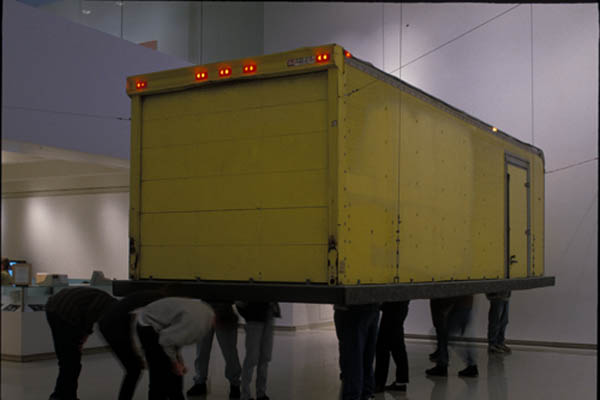
British artist Steven Pippin made images using a shipping container transformed into a multi-pinhole camera for "Brilliant!": New Art from London, a mid-1990s Walker Art Center exhibit. The camera recorded images of the space--the museum's Vineland Place lobby--in which it was hung during the show, high enough for people to duck under and view the work from inside out. Here are two views of the installation.


Steven Pippin, Introduction (1995)
Trailer, unique paper negative
Installation: “Brilliant!” New Art from London, October 22, 1995 – January 7, 1996
Outer Lobby, Walker Art Center
Photo Credit: Dan Dennehy for Walker Art Center
Another way to measure the phenomenon is to consider the dimensions of the surface receiving the image. Abe Morell has certainly proven his ability to project and capture image in large spaces, and Aaron Bommarito recently transformed the Minnesota Center for Photography in Minneapolis, 12-foot ceilings and all, into a walk-in camera obscura.
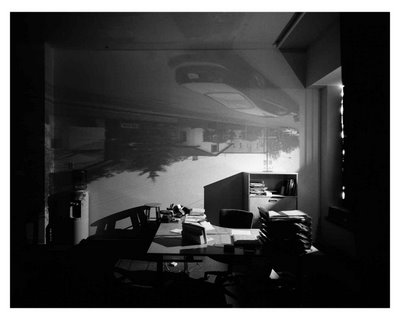
Aaron Bommarito, Interior, Minnesota Center for Photography, May 2006 (copyright 2006 Aaron Bommarito)
I guess records are made to be broken--sometimes by will, sometimes by retrospect, knowing what's come before but has perhaps been unchronicled.
Anyone who's seen Vera Lutter's work knows that large images from airfields have already been secured; I'm not sure if she worked in a darkened hangar, but what other obscurable room would have been available to make the enormous black-and-white prints of airplanes she's exhibited in Chelsea and elsewhere? She made one of the Nabisco box printing factory in Beacon, NY (now the home of Dia:Beacon) that measures about 9 x 14 feet.
British artist Steven Pippin made images using a shipping container transformed into a multi-pinhole camera for "Brilliant!": New Art from London, a mid-1990s Walker Art Center exhibit. The camera recorded images of the space--the museum's Vineland Place lobby--in which it was hung during the show, high enough for people to duck under and view the work from inside out. Here are two views of the installation.

Steven Pippin, Introduction (1995)
Trailer, unique paper negative
Installation: “Brilliant!” New Art from London, October 22, 1995 – January 7, 1996
Outer Lobby, Walker Art Center
Photo Credit: Dan Dennehy for Walker Art Center
Another way to measure the phenomenon is to consider the dimensions of the surface receiving the image. Abe Morell has certainly proven his ability to project and capture image in large spaces, and Aaron Bommarito recently transformed the Minnesota Center for Photography in Minneapolis, 12-foot ceilings and all, into a walk-in camera obscura.
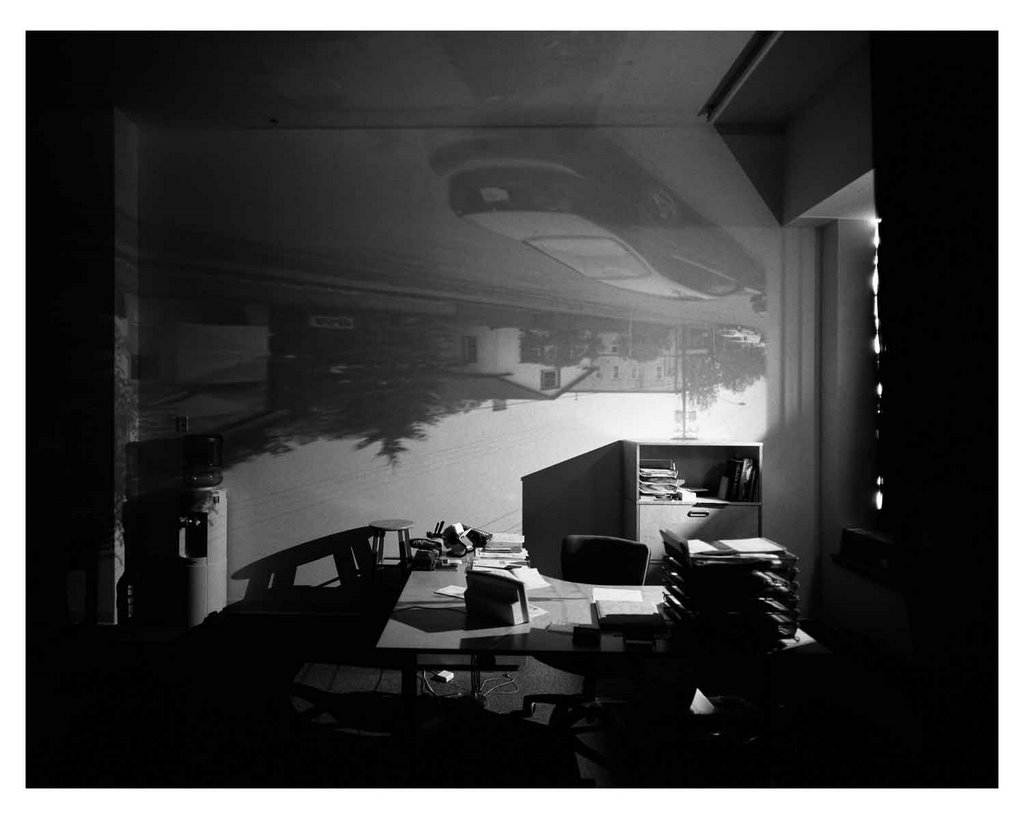
Aaron Bommarito, Interior, Minnesota Center for Photography, May 2006 (copyright 2006 Aaron Bommarito)
I guess records are made to be broken--sometimes by will, sometimes by retrospect, knowing what's come before but has perhaps been unchronicled.
Subscribe to:
Posts (Atom)

 Posts
Posts

